What Toys Are Good for Cats

If you live with a cat, you probably know how quickly they can turn almost anything into a toy. A cardboard box, a paper ball, or even a piece of string can suddenly become the most exciting thing in the house.
But choosing the best toys for cats is about more than keeping them entertained. The right toys can encourage exercise, provide mental stimulation, support natural hunting behaviors, and help prevent boredom—especially for indoor cats.
So, what toys are good for cats?
The best choices usually include interactive wand toys, balls, catnip toys, puzzle feeders, tunnels, kicker toys, and safe scratching toys. However, every cat is different. A toy that one cat loves may be completely ignored by another.
This guide explains the different types of cat toys, their benefits, how to choose them safely, and how to keep your cat interested in play.
Why Do Cats Need Toys?
Cats are natural predators. Even domesticated cats retain many behaviors associated with hunting, including stalking, chasing, pouncing, grabbing, and batting objects.
Toys give cats an appropriate way to express these behaviors.
Regular play can help provide:
- Physical activity
- Mental stimulation
- Opportunities to practice hunting behaviors
- Environmental enrichment
- Variety and novelty
- Positive interaction with their owners
For indoor cats, toys can be particularly useful because they may have fewer opportunities to explore and hunt than cats that spend time outdoors.
However, toys should complement—not replace—interaction, exploration, scratching opportunities, and other forms of environmental enrichment.
1. Interactive Wand Toys
Interactive wand toys are among the most useful toys for cats because they allow you to control the movement of the toy.
A typical wand toy has a handle with a flexible attachment such as feathers, fabric, or another lure. You can move it across the floor, around furniture, or through a tunnel to encourage your cat to chase and pounce.
Why do cats like wand toys?
Their unpredictable movement can resemble the movement of prey. This can encourage behaviors such as:
- Watching
- Stalking
- Chasing
- Pouncing
- Grabbing
How to use a wand toy
Instead of moving the toy continuously in front of your cat, try varying the movement. Let it disappear behind furniture, pause occasionally, and then move again.
Allowing your cat to catch the toy periodically can also make the game more satisfying.
Important safety tip
Do not leave wand toys with strings, cords, or similar attachments lying around when your cat is unsupervised. Store them safely after interactive play.
2. Balls
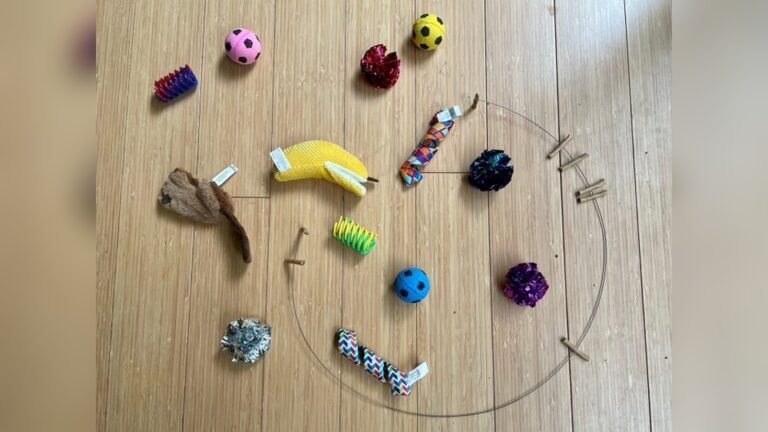
Balls are simple but popular cat toys. Many cats enjoy batting a ball across the floor and chasing it as it rolls away.
You can find balls made from different materials, including lightweight plastic, foam, fabric, and other cat-safe materials.
Some balls also make sounds when they move.
What makes a good cat ball?
Look for a ball that is:
- Large enough that it cannot easily be swallowed
- Appropriate for your cat’s size
- Durable
- Free from easily detachable parts
- Easy for your cat to bat around
Some cats prefer lightweight balls that move quickly, while others may prefer heavier or textured toys.
3. Catnip Toys
Catnip toys contain catnip, an herb that can cause a temporary behavioral response in some cats.
Not every cat responds to catnip. If your cat ignores a catnip toy, that does not necessarily mean there is anything wrong with them.
Popular catnip toys include:
- Catnip mice
- Catnip cushions
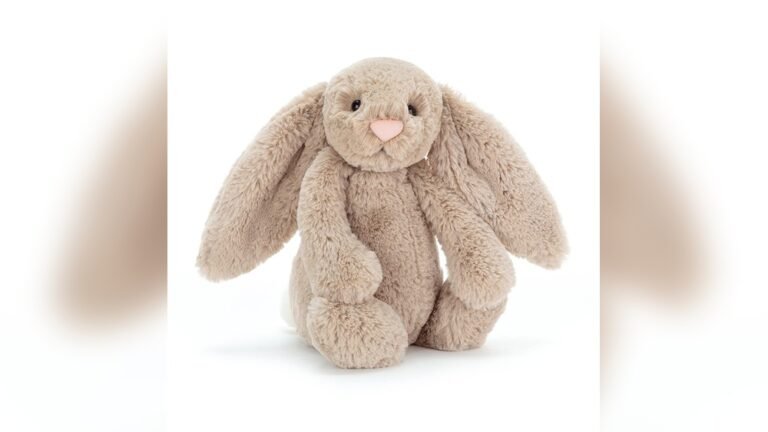
- Stuffed animals
- Catnip balls
- Catnip kicker toys
Are catnip toys good for cats?
For cats that respond to catnip, these toys can provide an additional form of enrichment.
Introduce catnip toys occasionally rather than assuming your cat will want to play with them every day.
Always inspect stuffed toys for damage and replace them if they become torn or develop loose pieces.
4. Puzzle Toys and Treat-Dispensing Toys
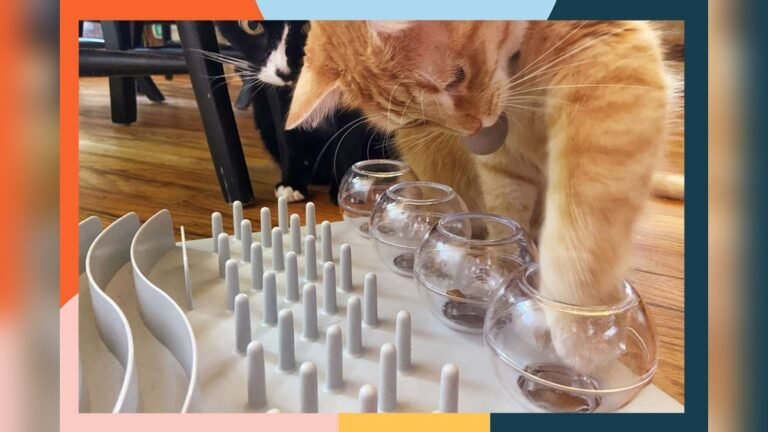
If your cat enjoys solving problems or working for food, puzzle toys for cats can be an excellent choice.
These toys require a cat to manipulate an object or complete a simple task to access food or treats.
They can encourage:
- Problem-solving
- Exploration
- Foraging behavior
- Mental stimulation
Start with an easy puzzle
If your cat has never used a puzzle toy, start with a simple design.
Show your cat how the toy works and make the reward easy to access initially. Once your cat understands the game, you can gradually introduce more challenging puzzles.
Remember to account for treats or food used in puzzle toys when considering your cat’s overall daily food intake.
5. Cat Tunnels
Many cats enjoy enclosed spaces, and cat tunnels can provide opportunities to hide, explore, chase, and ambush toys.
A tunnel can become even more interesting when combined with an interactive toy.
For example, you can move a wand toy past the tunnel entrance and allow your cat to stalk it from inside.
What to look for in a cat tunnel
Choose one that is:
- Stable enough for your cat
- Appropriate for their size
- Made from cat-safe materials
- Free from damaged or exposed components
Check the tunnel regularly, especially if your cat likes to scratch or chew it.
6. Toy Mice and Prey-Shaped Toys
Small prey-shaped toys can appeal to a cat’s natural hunting behavior.
Toy mice are particularly useful for cats that enjoy carrying, batting, chasing, or tossing objects.
Some cats like to play independently with these toys, while others prefer when their owner moves them around.
Try different textures and sizes to discover what your cat prefers.
7. Kicker Toys
Kicker toys are longer stuffed toys designed for cats to grab with their front paws and kick with their back legs.
They can be especially appealing during energetic play.
Some kicker toys are filled with catnip, while others contain no catnip at all.
Choose a kicker toy that is large enough for your cat to grab comfortably but not so large that it becomes difficult to move.
8. Scratching Toys
Scratching is normal feline behavior, so scratching products are an important part of a cat-friendly home.
Scratching posts and pads can give cats an appropriate place to scratch while also providing physical activity.
Different cats prefer different scratching surfaces and positions.
Some prefer:
- Vertical scratching posts
- Horizontal scratching pads
- Angled scratchers
- Cardboard scratchers
- Sisal-covered posts
If your cat ignores a scratching post, try changing its location, orientation, or material.
9. Electronic and Automatic Cat Toys
Automatic toys can move, roll, or otherwise interact with a cat without requiring you to continuously control the toy.
These can be useful for adding variety to your cat’s routine.
However, automatic toys should not completely replace interactive play with people.
Safety matters
Follow the manufacturer’s instructions and regularly inspect electronic toys for damage, loose components, batteries, or other hazards.
Do not assume that a toy is safe to leave with your cat simply because it is marketed as an automatic cat toy.
10. Laser Pointers
Laser pointers can encourage cats to chase a moving light and provide physical activity.
However, a laser dot cannot actually be caught.
For this reason, it can be useful to finish a laser-play session by offering a physical toy that your cat can successfully catch and interact with.
Never shine a laser directly into your cat’s eyes.
11. Crinkle Toys and Noisy Toys
Some cats are attracted to toys that make sounds when touched.
Crinkle toys, bells, and other sound-producing toys can provide variety.
However, individual preferences differ considerably. Some cats love noisy toys, while others prefer quiet toys.
If your cat becomes frightened or stressed by a particular sound, stop using that toy.
12. What Toys Are Best for Kittens?
Kittens generally benefit from toys that encourage movement, coordination, exploration, and play.
Good options may include:
- Lightweight balls
- Soft toys
- Interactive wand toys used under supervision
- Small tunnels
- Appropriate kicker toys
- Simple puzzle toys
Avoid toys containing small detachable components that could become choking or swallowing hazards.
Because kittens can be particularly curious, inspect their toys frequently.
13. What Toys Are Best for Adult Cats?
Adult cats can enjoy a wide variety of toys.
A good selection might include:
- An interactive wand toy
- A few balls
- A tunnel
- A prey-shaped toy
- A puzzle or treat toy
- A scratching post or pad
Rather than buying dozens of toys, observe what your cat actually enjoys.
Does your cat like chasing?
Choose moving toys.
Does your cat enjoy batting objects?
Try balls and lightweight toys.
Does your cat enjoy food-based activities?
Try puzzle feeders.
Does your cat enjoy stalking?
Try tunnels and interactive prey-style toys.
14. What Toys Are Best for Senior Cats?
Older cats may still enjoy playing, but their physical abilities can change with age.
Consider toys that encourage gentle movement without requiring excessive jumping or sudden movements.
Examples include:
- Soft toys
- Lightweight balls
- Gentle wand play
- Food puzzles suited to their abilities
- Comfortable scratching surfaces
If your older cat suddenly stops playing or appears uncomfortable during movement, discuss the change with a veterinarian rather than assuming it is simply part of aging.
15. Best Toys for Indoor Cats
Indoor cats can benefit from having different forms of enrichment available.
A useful combination may include:
For exercise:
Wand toys, balls, and chase toys.
For mental stimulation:
Puzzle feeders and food-dispensing toys.
For hiding and exploration:
Tunnels and appropriate hiding spaces.
For natural scratching behavior:
Scratching posts and pads.
For independent play:
Safe balls and durable toys without hazardous loose parts.
The goal is not simply to provide more toys. The goal is to provide different types of activities.
How to Choose Safe Toys for Cats
Safety should always be more important than appearance or price.
Before giving your cat a toy, consider whether it contains parts that could be swallowed or become detached.
Check toys regularly
Inspect toys for:
- Tears
- Loose stitching
- Detached pieces
- Exposed filling
- Broken plastic
- Loose strings
- Damaged electronic components
Discard or repair toys when appropriate.
Be careful with string and ribbon
String-like objects can be dangerous if swallowed. Toys containing strings, ribbons, elastic, or similar components are best used only when you can supervise the cat.
Never allow a cat to play unsupervised with a potentially hazardous toy.
How Often Should You Play With Your Cat?
There is no single play schedule that works for every cat.
A cat’s age, health, personality, energy level, and environment all influence how much play they want.
Instead of focusing only on the clock, watch your cat’s behavior.
A play session can involve:
- Introducing the toy.
- Allowing your cat to watch and stalk it.
- Encouraging chasing and pouncing.
- Letting the cat catch the toy.
- Ending the session when the cat loses interest.
Short, engaging sessions can be more useful than simply leaving toys on the floor and expecting your cat to entertain itself.
Why Does My Cat Lose Interest in Toys?
It is common for cats to become bored with toys that are always available.
Try rotating toys instead of leaving every toy out at once.
For example, keep several toys stored away and introduce different ones periodically.
You can also vary:
- Movement
- Texture
- Sound
- Location
- Type of activity
A toy that seems boring one week may become interesting again after some time away.
Should You Buy Expensive Cat Toys?
Not necessarily.
The most expensive cat toy is not automatically the best toy.
Many cats enjoy relatively simple objects and activities. What matters is whether the toy provides an appropriate opportunity for movement, exploration, play, or mental stimulation.
Before spending a lot of money, observe what your cat naturally enjoys.
If your cat loves chasing moving objects, an interactive toy may be more useful than an expensive electronic toy.
If your cat loves food-based challenges, a puzzle feeder may be a better investment.
Can Cats Play With Household Objects?
Cats are often attracted to everyday objects, but not everything that looks fun is safe.
Paper balls and cardboard boxes can provide enrichment, but household objects should still be checked for hazards.
Avoid allowing your cat to play with objects that contain:
- Sharp edges
- Small pieces
- Toxic materials
- Long strings
- Rubber bands
- Easily swallowed components
- Chemicals or residues
If you are unsure whether an object is safe, choose a purpose-made cat toy instead.
How to Create a Good Cat Toy Collection
You do not need a huge collection.
A practical selection could include:
- One or two interactive wand toys
- Several safe balls
- A prey-shaped toy
- A kicker toy
- A tunnel
- A puzzle feeder
- A scratching post or pad
- A few additional toys your cat particularly enjoys
Rotate the selection to keep the environment interesting.
Most importantly, pay attention to your individual cat’s preferences.
Frequently Asked Questions About Cat Toys
What is the best toy for a cat?
There is no single best toy for every cat. Interactive toys, balls, puzzle toys, tunnels, kicker toys, and scratching products can all be useful. The best choice depends on the cat’s age, personality, physical ability, and preferred type of play.
What toys do cats like the most?
Many cats enjoy toys that move unpredictably and allow them to chase, stalk, pounce, and catch. However, preferences vary from one cat to another.
Are catnip toys safe for cats?
Catnip toys are generally used as enrichment products, but individual cats respond differently to catnip. Inspect toys regularly and remove damaged toys.
Are laser pointers good for cats?
Laser play can encourage chasing and movement, but cats cannot physically catch the light. Ending the session with a toy that the cat can catch may provide a more complete play experience. Never shine a laser into a cat’s eyes.
How often should I replace cat toys?
Replace a toy when it becomes damaged, develops loose parts, or presents a potential hazard. The lifespan of a toy depends on its construction and how aggressively the cat plays with it.
Do indoor cats need toys?
Indoor cats can benefit from toys and other forms of environmental enrichment. Toys can provide opportunities for physical activity, exploration, and play.
Why does my cat not like toys?
Your cat may simply prefer a different type of toy or movement. Try different textures, shapes, speeds, and play styles. If a cat suddenly loses interest in play, especially along with other behavioral or physical changes, consider speaking with a veterinarian.
Final Thoughts: What Toys Are Good for Cats?
So, what toys are good for cats?
The answer depends on the individual cat, but a combination of interactive toys, balls, puzzle toys, tunnels, prey-shaped toys, kicker toys, and scratching products can provide a good range of activities.
The most important thing is not to buy as many toys as possible. Instead, provide safe options that encourage different natural behaviors and pay attention to what your cat actually enjoys.
For many cats, the best toy may be one that allows them to stalk, chase, pounce, catch, explore, or solve a simple problem.
Rotate toys regularly, supervise potentially hazardous toys, replace damaged items, and make interactive play part of your cat’s daily enrichment routine. A good cat toy does more than keep a cat busy—it can help make their indoor environment more interesting, active, and rewarding.